Case study
Cairn
A card-sized e-paper companion with one crown, and Fell, the small-screen OS that shows one thing at a time.
Cairn is a personal project about the smallest screen an agent should need. Cairn S is a concept device: a ceramic card 54 by 85.6 mm and 7.2 mm thick, worn on a lapel clip or snapped to the back of a phone. It has a colour e-paper screen, a titanium crown on the right edge and a thin light along the left. Fell is the software on it, and it runs on the same Kotlin engine as Wayfinder.
One stone at a time
Fell has one rule. A stone is a full screen that holds one thing, like the next turn on a walk or a table to confirm, and it never scrolls. The crown moves through a deck of stones, and the first stone is always the one that needs you most. Anything longer than four lines goes to your ear or your phone, and the stone that stays says where it went.
A stone is a moment, a decision or the handled stone. A moment is something worth a look. A decision shows the question, one line of context and two or three answers. Everything the agent did quietly collects into one handled stone at the end of the deck.
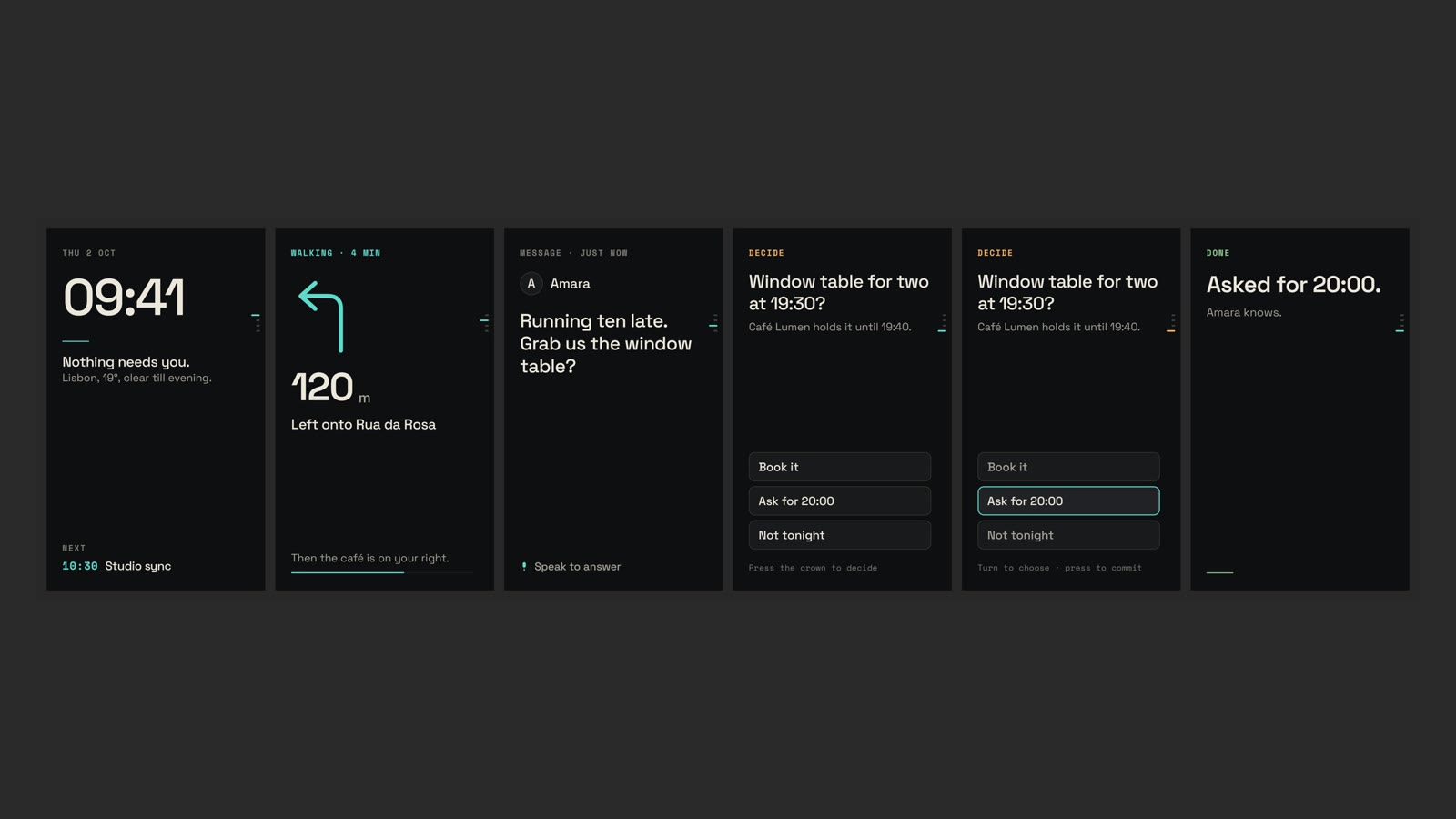
Done shows what happened
A committed decision never ends on a single word. Its stone shows the context of the action: the place and time, the table itself, the walk there and who has been told. Anything still waiting shows in amber, with what it is waiting on and what stays held until then.
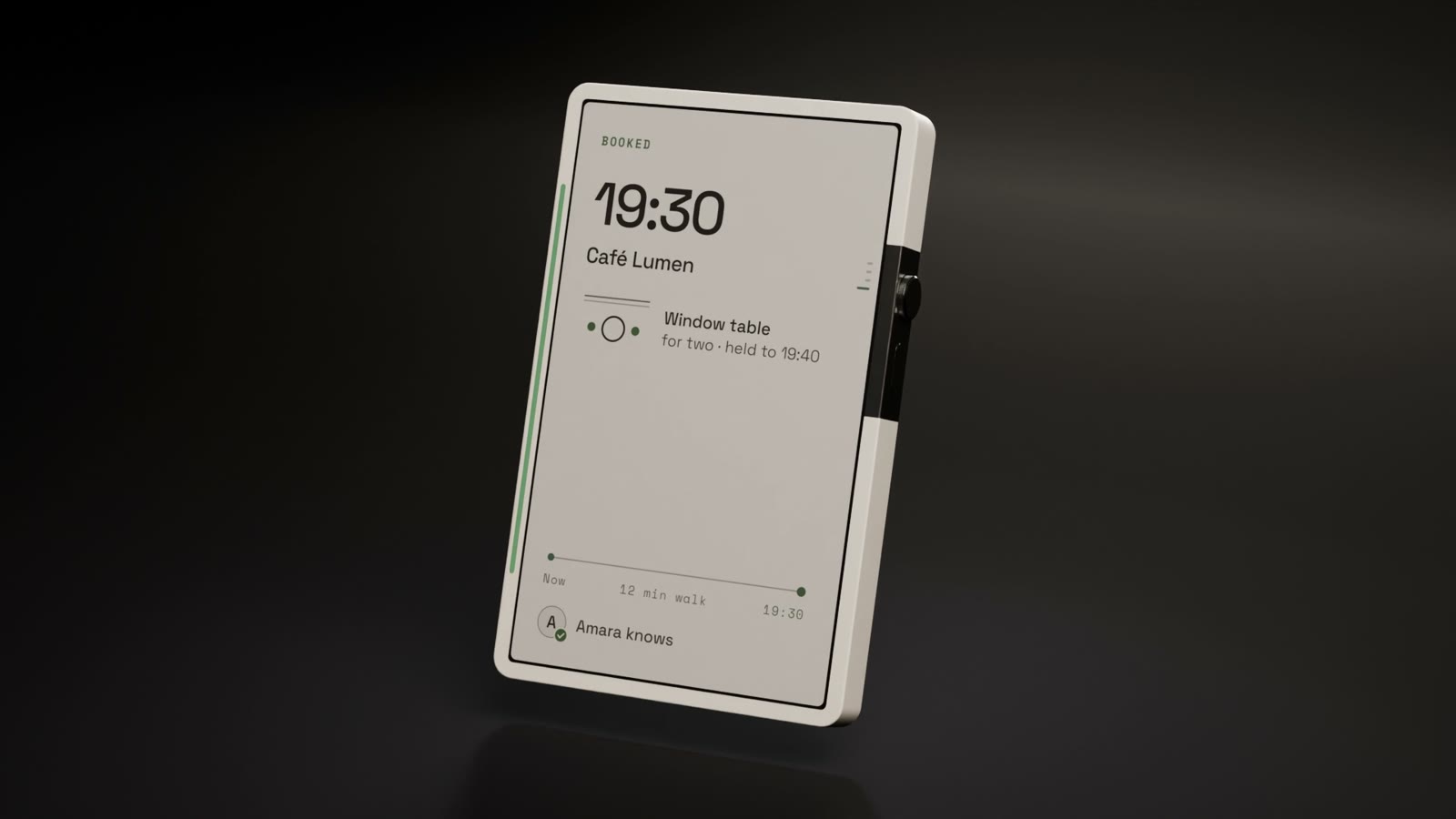
The crown commits, the line tells you
Turn the crown to move through the deck. On a decision, press to take it in hand, turn to choose and press again to commit. Press and hold anywhere to speak. When a commit has an undo window, an amber line shrinks toward the crown, and a press inside it undoes.
The light along the left edge is the status bar, and it is the only part of the card that glows. Teal means listening or working, amber means a decision is waiting, moss means it landed and rose means it failed. It never shows content.
Interruption follows the oversight levels Wayfinder computes. A silent item goes straight to the handled stone. A review item moves to the top as a decision and pulses the line once. A hold item stays on top until you deal with it, and Cairn says one line in your ear.
E-paper sets the rules
The screen is e-paper, so a stone arrives in one refresh, with no slides or spinners. The edge light does all the moving. Colour is only for signal, and body text is ink on paper. Pictures are two or three tones, line drawings where possible. The guide sets the details: body type at 15 sp or more, a full refresh every eight partial updates to clear ghosting, and a warm front light only below about 50 lux.
Answering on a card
The card sits in one hand with the thumb low on the glass, so all touch lives in the bottom half and the thumb never has to be precise. Most replies need no typing. Fell drafts three answers and you turn the crown to one.
For your own words there is an arc keyboard bent along the thumb's sweep. The keys are 4.4 mm apart, too small to tap and plenty to trace through. Lift to keep the best guess, or turn the crown for another. For anything longer, hold the crown and speak, and any doubtful word comes back underlined so you can fix it.
The keyboard became a real one
I wanted to know whether the arc keyboard worked under a real thumb, so I built it as an Android input method, Cairn Keys, and used it on my own phone. It started as a card-sized keyboard floating in the corner of any app, with its arcs bent toward whichever thumb is using it. Later versions added a full-width shape, a larger word list, next-word suggestions and autocorrect.
A replay harness scores the decoder against traced words. In October, elastic matching of the trace raised the right word in first place from 58% to 75% of the time on synthetic traces of common words, and into the top three 91% of the time.
A real voice turn
Hold to speak also runs for real in the Android build. The recording goes to a small service on my own machines: Whisper transcribes it, a local language model answers, and Kokoro speaks the answer. Nothing leaves my home network.
The model knows which deck is on the card. It can move to a stone or commit a choice on a decision stone, and the app applies that action. It cannot invent a stone.
In the recording below, the card is showing a message from Ren. The emulator has no microphone, so a synthetic voice stands in for the wearer. Everything after that is the real turn: it took about two seconds, with 0.35 s to hear, 1.4 s to think and 0.35 s to speak. The model sent the reply, said so in your ear, and moved the card on to the walk.
Apps as generated surfaces
In the later films I tried a different idea of an app. Docs, music, mail, messages and a recurring report are surfaces generated from the same fixed stones. Each task keeps a remembered shape, so the second time it appears it looks like the first. This part exists as captures and films only.
Every Wayfinder surface lands as stones
Fell lives in the same Kotlin codebase as Wayfinder. Cairn S is one more device profile, and a projection step turns any Wayfinder surface into a deck of stones, with a test that checks it. Triage, a household plan or a drafted reply built for a larger screen also runs on the card, at the same oversight level it had there.
What it does not claim
Cairn S is a concept, and I built no hardware. The films are offline renders, and the screens in them are captures from the Android build on an emulator. The stones, the decks, the projection from Wayfinder, the crown and edge-light states, the voice turn and Cairn Keys all run. The physical crown, the LED edge light, the earbud chime and the front light are specified only.
A hardware desk study found the 7.2 mm thickness tight but possible, if the card runs a small low-power chip that receives finished stones from the phone. That plan gives an estimated two to four weeks of battery. The study also found two real problems. No colour e-paper sold at 3.7 inches refreshes fast enough for a crown, and neither the panel with its border nor a standard magnetic charging ring fits a body 54 mm wide. The fixes are a fast mono panel for a first prototype, or a slightly larger card.